ISOC-8.1.2.1 Crafting Hypotheses: Proposing Explanations and Testable Predictions
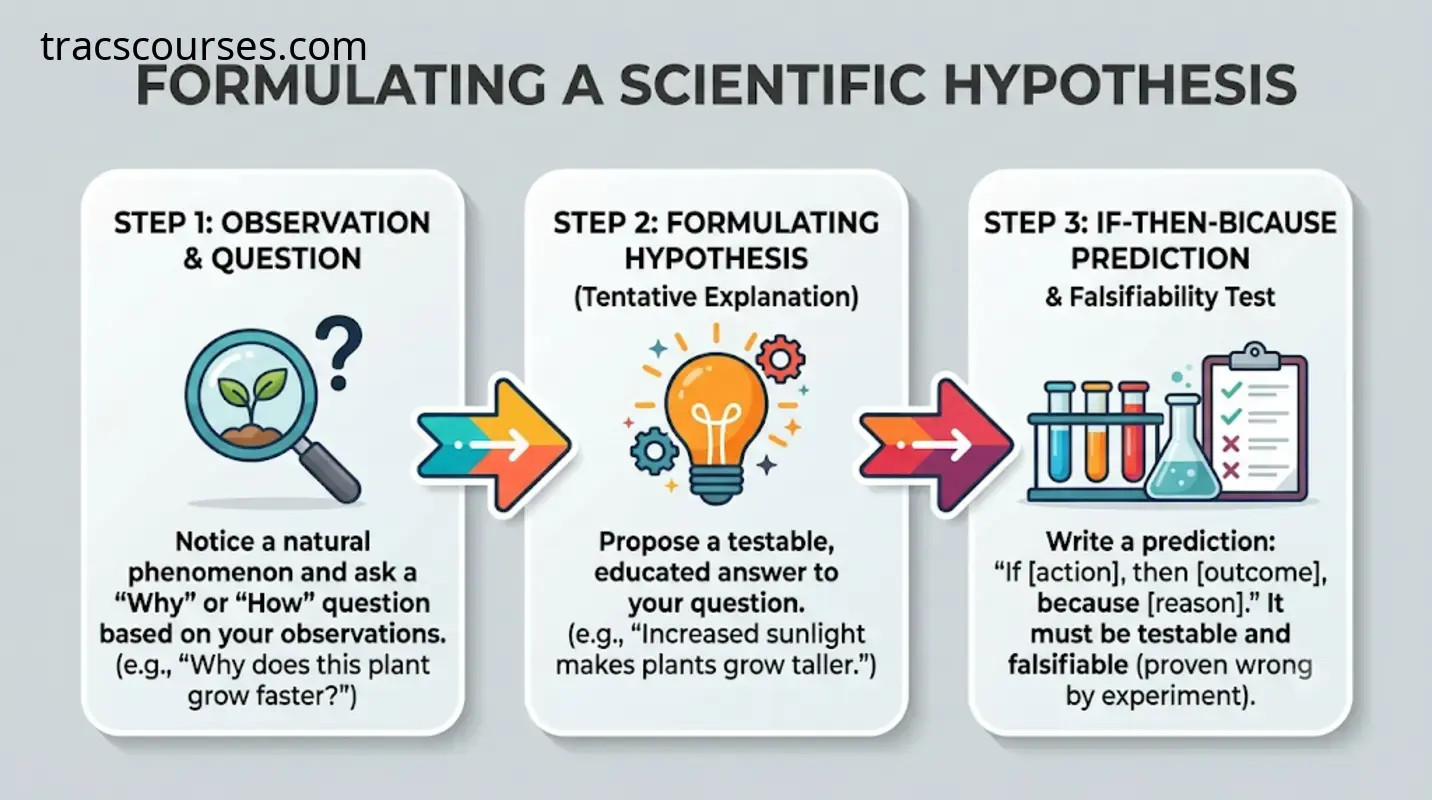
Once a testable question has been formulated and preliminary observations have been gathered, scientists develop a hypothesis. A scientific hypothesis is not merely an uneducated guess; it is a tentative, testable explanation grounded in prior knowledge, scientific principles, and initial observations. It proposes a potential mechanism for an observed phenomenon that can either be supported or refuted through rigorous experimentation.
To test a hypothesis effectively, scientists derive specific predictions often structured in an ‘If… then… because…’ format. The ‘If’ clause describes the manipulated condition, the ‘then’ clause states the measurable expected outcome, and the ‘because’ clause explains the underlying scientific reasoning. For example: ‘If water temperature increases, then yeast will produce carbon dioxide gas at a faster rate, because enzyme activity increases with thermal energy up to an optimal point.’ A valid hypothesis must always be falsifiable, meaning there exists a conceivable observation that could prove it false.
ISOC-8.1.2.2 Controlling the Experiment: Independent, Dependent, and Controlled Variables
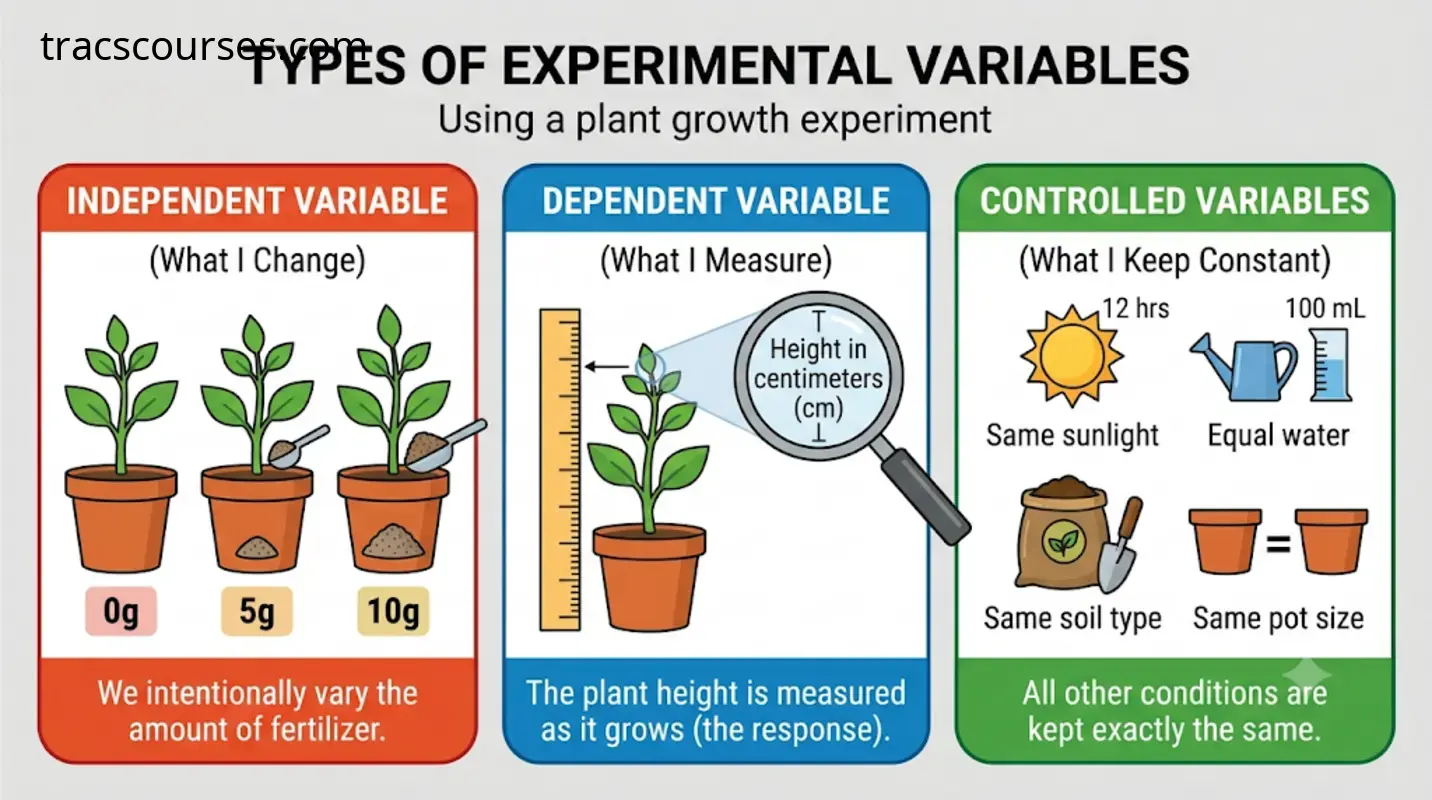
In any scientific experiment, variables are factors, traits, or conditions that can exist in differing amounts or types. To establish a rigorous cause-and-effect relationship, scientists categorize variables into three distinct groups: independent, dependent, and controlled. The independent variable is the single condition deliberately altered or manipulated by the investigator to observe its effects. The dependent variable is the factor being tested and measured; its values are expected to change in response to modifications in the independent variable.
Controlled variables, also referred to as constants, represent all the other external factors that must remain strictly unchanged throughout the entire investigation. If extraneous variables such as ambient temperature, container volume, or exposure time are not held constant, they can confound the results, making it impossible to determine whether the observed changes were truly caused by the independent variable.
For instance, when investigating how salt concentration affects the boiling point of water, the amount of dissolved salt is the independent variable, and the temperature at which water begins to boil is the dependent variable. Crucial controlled variables would include using the same volume of distilled water, identical heating equipment, and consistent atmospheric pressure. By systematically isolating the independent variable, researchers ensure that their experimental findings are scientifically valid and reproducible.
ISOC-8.1.2.3 Ensuring Reliability: Designing Fair Tests and Replicate Trials
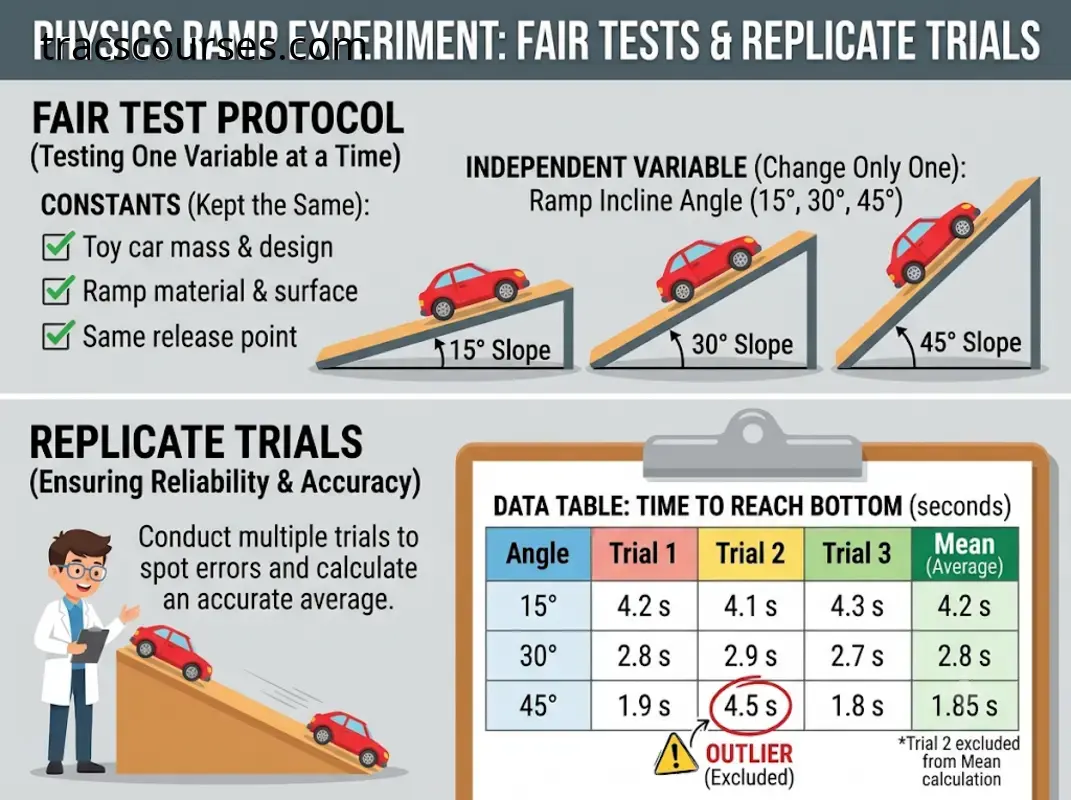
A fair test is the cornerstone of scientific experimentation. It is conducted by ensuring that only one independent variable is manipulated at a time while all other conditions are kept strictly constant. If an experiment changes multiple factors simultaneously—such as testing both a new fertilizer brand and a higher watering schedule—it becomes fundamentally impossible to attribute any difference in outcome to a specific cause. A properly designed fair test isolates the intended factor, ensuring that the collected data directly answers the original investigative question.
Even in a meticulously planned fair test, random experimental variations, minor measurement errors, and biological differences among specimens can skew findings from a single trial. To overcome this limitation, scientists incorporate replicate trials and adequate sample sizes. Repeating an investigation multiple times under identical conditions allows researchers to calculate mathematical averages, identify anomalies or outliers, and verify that the observed effects are dependable and not merely accidental occurrences.
Replication also provides the foundation for peer review and scientific verification. When independent scientists can reproduce the same experimental procedure and obtain statistically consistent results, the conclusions gain widespread credibility within the scientific community. High reliability achieved through repeated trials transforms isolated observations into robust scientific knowledge.