ISOC-8.1.4 Scientific Ethics and Laboratory Practices (M)

Easy

ISOC-8.1.4.1 Safety First: Laboratory Apparatus, Safety Protocols, and Hazard Symbols
Safety First: Laboratory Apparatus, Safety Protocols, and Hazard Symbols

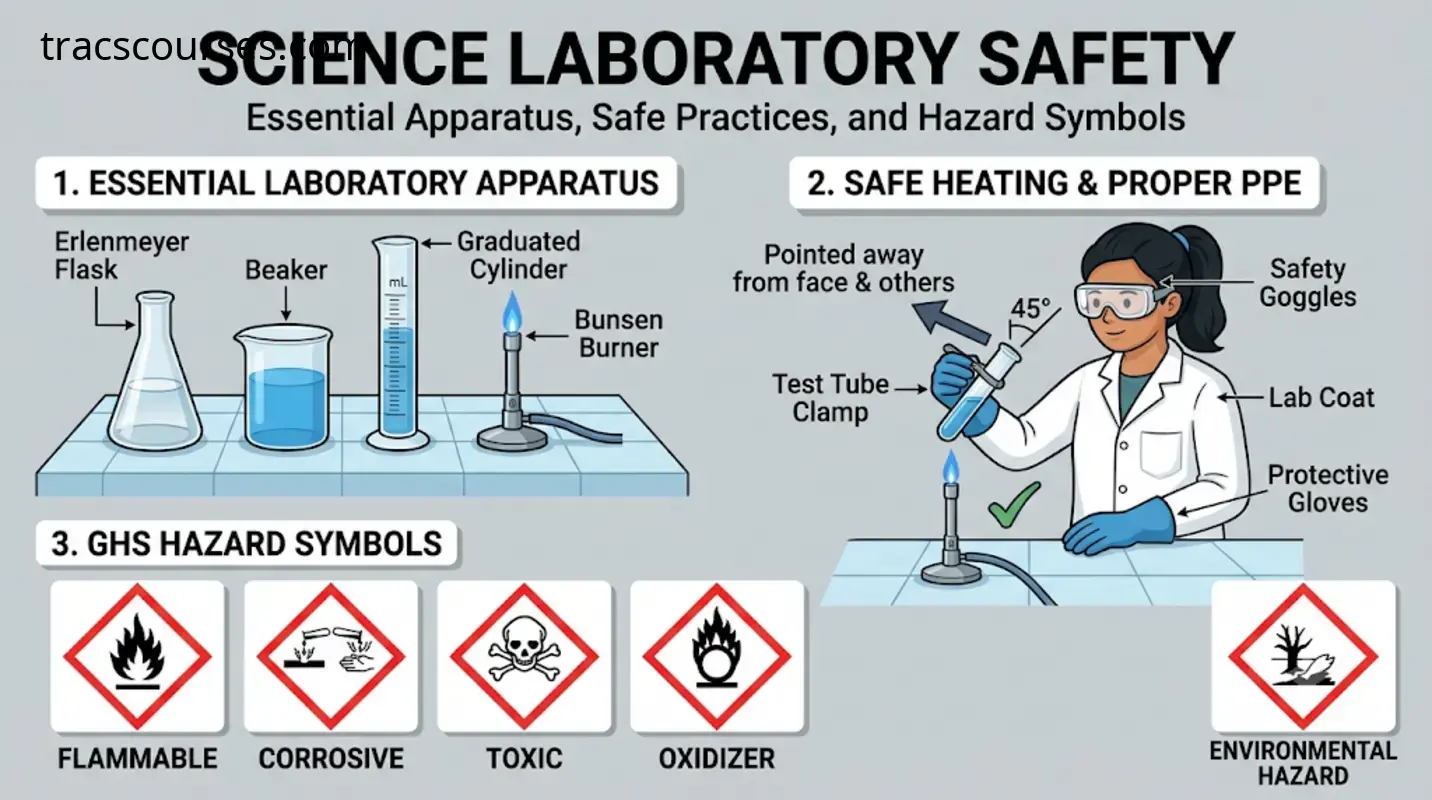
Laboratory investigations require specialized apparatus designed for precise heating, mixing, measuring, and handling of chemical substances. Common glassware and equipment include beakers, Erlenmeyer flasks, test tubes, Bunsen burners, wire gauzes, and graduated pipettes. Safely operating these tools requires an understanding of their specific functions and thermal limits; for example, borosilicate glassware must be inspected for hairline fractures before being subjected to direct flames, and test tubes must always be held with test tube clamps angled away from people while heating.

Maintaining a safe investigative environment depends on strict adherence to established laboratory safety protocols. Personal Protective Equipment (PPE)—including splash-proof chemical goggles, heat-resistant gloves, and laboratory coats—provides an essential barrier against thermal burns, chemical splashes, and flying debris. Standard operating rules prohibit eating, drinking, or running in the lab, and dictate emergency responses such as the immediate use of eyewash stations, safety showers, fire blankets, and sand buckets during chemical spills or accidental fires.

Standardized internationally recognized hazard pictograms communicate chemical risks instantly, eliminating language barriers in laboratories worldwide. Common Globally Harmonized System (GHS) symbols include the flame (indicating flammable or combustible substances), the flame over circle (oxidizers), the corrosive symbol showing corroding metal and skin (acids and bases), the skull and crossbones (acute toxicity), and the environmental toxicity symbol depicting a dead tree and fish. Recognizing and interpreting these hazard warnings ensures that students and scientists handle reactive reagents with appropriate containment and precautions.

Easy
Which piece of personal protective equipment (PPE) is most critical to protect the eyes from unexpected chemical splashes during a laboratory reaction?
Option B is correct because chemical splash goggles are specifically engineered to form a tight, complete protective seal around the eyes, shielding them against liquid splashes and chemical fumes. Options A and C are incorrect because standard reading glasses and sunglasses do not seal against side splashes or hazardous vapors. Option D protects the respiratory tract or mouth, not the eyes.
Medium
When heating a liquid in an open test tube over a Bunsen burner flame, what is the correct safety protocol to prevent accidents?
Option C is correct because directing the open mouth of the test tube away from all individuals prevents hot liquids or sudden boiling vapors from ejecting onto anyone. Option A is dangerous and violates basic lab safety. Option B causes severe thermal burns because glass conducts heat rapidly; a test tube clamp must be used. Option D creates a sealed pressure vessel that will violently explode when heated liquids turn to steam.
Tricky
A chemical reagent bottle bears a Globally Harmonized System (GHS) pictogram showing an exclamation mark inside a red diamond, while another bottle displays a flame over a circle. What do these hazard symbols signify?
Option C is correct because the GHS exclamation mark pictogram denotes acute toxicity (harmful), skin/eye irritation, or narcotic effects, while the ‘flame over circle’ pictogram uniquely identifies oxidizers (substances that release oxygen and intensify combustion of other materials). Option A confuses oxidizers with flammable solids. Option B incorrectly assigns explosion to the exclamation mark (exploding bomb is used for explosives) and misidentifies oxidizers as simple flammable liquids. Option D confuses GHS chemical pictograms with distinct biohazard and radiation warning symbols.
Medium

ISOC-8.1.4.2 Separating Myth from Reality: Empirical Evidence and Scientific Skepticism
Separating Myth from Reality: Empirical Evidence and Scientific Skepticism

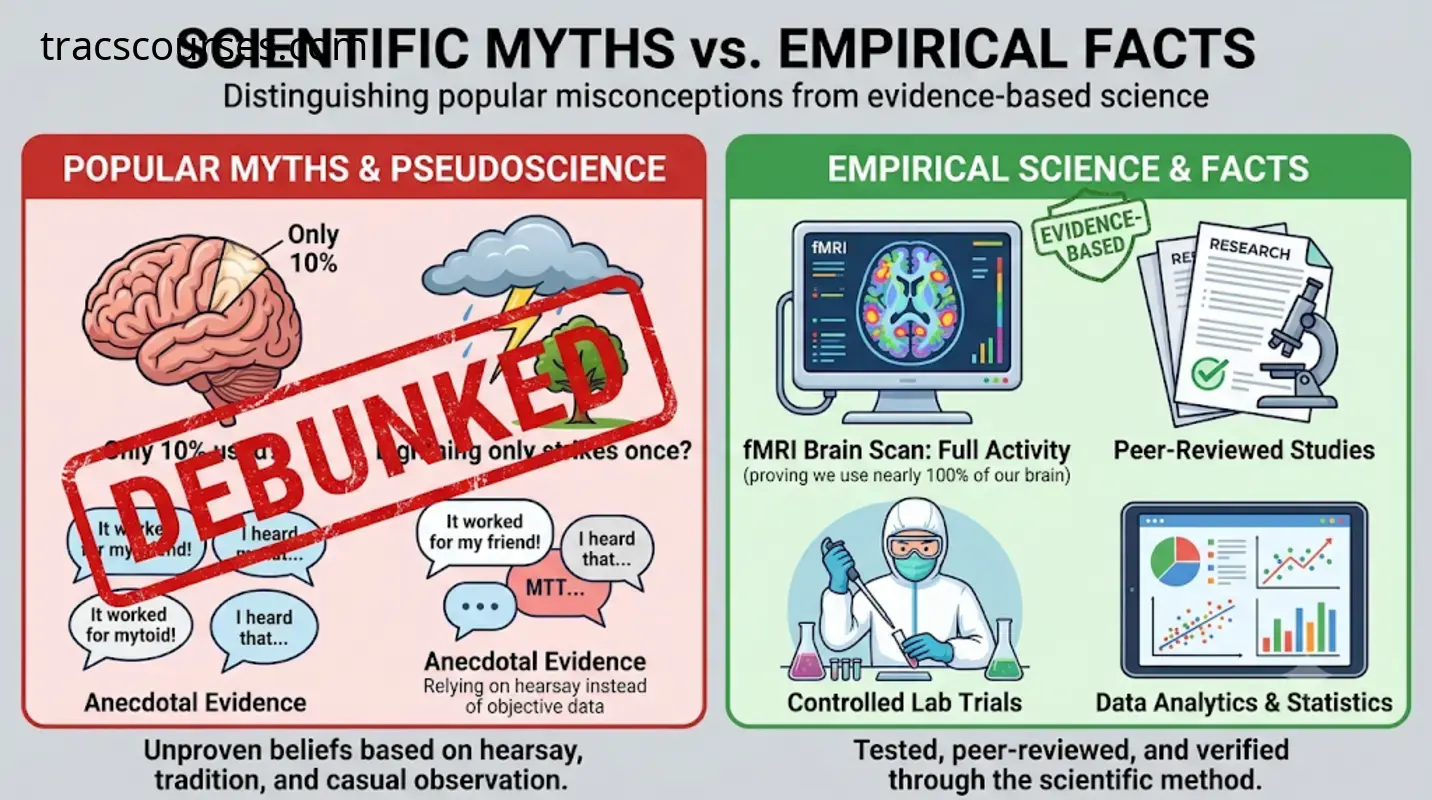
Science progresses by questioning assumptions and testing beliefs against observable physical evidence. Throughout history, widespread folklore, cultural superstitions, and anecdotal tales have frequently been mistaken for scientific truths. Common misconceptions—such as lightning never striking the same spot twice, sugar directly causing hyperactivity, or humans using only ten percent of their brain capacity—often spread rapidly because they sound plausible or align with intuitive human biases. The scientific method serves as a systematic filter to dismantle these persistent myths through empirical investigation.

Establishing an empirical fact requires verifiable, repeatable evidence gathered through controlled experimentation and objective observation. Unlike opinions or subjective beliefs, empirical claims must withstand rigorous testing, peer review, and independent replication by other researchers across different laboratories. Scientific skepticism encourages researchers to maintain an open yet critically demanding mindset: demanding robust experimental proof, examining sample sizes, and looking for potential experimental biases before accepting any extraordinary claim as established scientific knowledge.

Distinguishing between pseudoscience and legitimate empirical science is critical in modern society, especially regarding healthcare, technology, and environmental policy. Pseudoscience often relies on selective confirmation bias, untestable assertions, emotional appeals, and unverified testimonials, while ignoring contradicting evidence. In contrast, genuine scientific inquiry remains self-correcting; it willingly modifies or discards long-held models whenever new, higher-quality empirical data proves them incorrect. Cultivating this analytical mindset empowers learners to critically evaluate media claims and ground their understanding in verified facts.

Easy
What fundamentally differentiates an empirical scientific fact from an unverified popular myth?
Option A is correct because empirical facts are derived from direct, objective observation and repeatable experimentation under controlled conditions, whereas myths are cultural or anecdotal beliefs lacking empirical verification. Option B is incorrect because widespread agreement does not make something an empirical fact. Option C is arbitrary and irrelevant to scientific methodology. Option D is incorrect because science is always open to testing and re-evaluation if superior evidence emerges.
Medium
A popular wellness advertisement claims that a certain herbal beverage ‘detoxifies the body and boosts energy levels.’ Which scientific approach should an investigator take to evaluate this claim?
Option B is correct because a randomized, double-blind controlled trial with an appropriate placebo group and measurable biomarkers eliminates investigator and participant bias, allowing empirical verification of causal efficacy. Option A is incorrect because testimonials represent subjective, non-blinded anecdotal evidence prone to the placebo effect. Option C is unscientific cynicism rather than objective skepticism. Option D has an inadequate sample size (n=1) and lacks controls, making the findings invalid.
Tricky
A common myth states that ‘humans only use 10% of their brains.’ Which neuroscientific evidence and evolutionary reasoning most decisively refutes this claim?
Option B is correct because advanced neuroimaging technologies consistently demonstrate that almost the entire brain is active across various cognitive and motor tasks. Furthermore, the brain consumes ~20% of the body’s metabolic energy despite comprising ~2% of body mass; natural selection would heavily select against maintaining massive unused neural tissue. Option A is false, as localized brain damage almost invariably results in distinct functional deficits. Option C is biologically inaccurate regarding body weight percentage. Option D misrepresents the neurological pathways of spinal reflexes and fails to support the 90% myth.